
Data-driven Top Tens and Emotionally driven opinions.



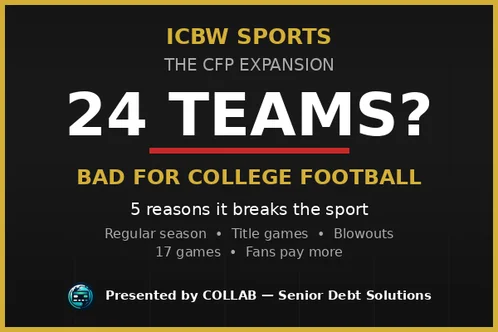
ICBW Sports: 24 Teams Will Break What Makes College Football Great
On November 9, the College Football Playoff Management Committee voted unanimously to double the playoff to 24 teams, starting with the 2027-28 season and locked in through 2031-32. Twenty-three playoff games. Nineteen at-large bids picked by a committee. Seeds 1 through 8 get a bye. Seeds 9 through 16 host seeds 17 through 24 in the first round.
The field grew from four teams to 12 before the 2024 season. Now, three seasons later, it doubles again. And college football is about to learn what every sport that chases inventory eventually learns: more playoff does not mean more drama. It means less of everything that made the regular season the best regular season in American sports.
Here are five reasons 24 is too many.
1. The regular season just lost its stakes
College football was built on scarcity. For most of its history, one loss could end a title chase and two losses did. Every Saturday mattered because the margin for error was almost zero. That is why a noon kickoff in October felt like a playoff game.
At 24 teams, a three-loss team is safely in. A four-loss team has a real shot. Lose your rivalry game? Lose on the road in November? Shrug it off — there are 19 at-large chairs and the committee will find you one. The sport's own announcement gives the game away: the CFP had to adopt new scheduling standards — at least 10 qualifying games, no credit for beating a second FCS opponent — to push teams to schedule real non-conference games. If the regular season still carried real consequences, nobody would need to be incentivized to play real games.
Television ratings are already down about 6 percent this season, with some networks down 10 percent or more. The answer to fans drifting away from a devalued regular season is not to devalue it further.
2. Conference championship games are gone
The power conferences have confirmed their 2026 championship games will be the final editions. Decades of title weekends — the SEC Championship in Atlanta, the Big Ten title game in Indianapolis, conference crowns decided on the field in December — are being traded away to fit an extra playoff round.
Under the new format, the four power conference champions still get automatic bids, but each conference decides how its champion is determined. A title decided by a tiebreaker in a conference office is not the same as a title won on a Saturday in front of 70,000 people. Fans lose a weekend that was, for many programs, the biggest game of the year. Players lose a trophy they grew up watching teams lift. And the sport loses one of its last events that actually felt like an event, all to clear a weekend for seeds 17 through 24.
3. More blowouts, not more drama
We already have two years of evidence at 12 teams, and it points the wrong way. In the first 12-team first round in 2024, the higher seed won all four games: Penn State beat SMU 38-10, Ohio State beat Tennessee 42-17, Texas beat Clemson 38-24, and Notre Dame beat Indiana 27-17. A combined 77 points of separation. In 2025, Ole Miss beat Tulane 41-10 and Oregon led James Madison by 35 points midway through the third quarter before winning 51-34.
Now add eight more teams below the ones that were already losing by four touchdowns. Seeds 17 through 24 are not title contenders. They are the teams that lost three or four times and still got invited. Nick Saban said it plainly: there are not 24 teams in the country that can win a national championship. He is right. The record book says the same thing. Adding teams that cannot win does not create Cinderella stories. It creates first-round games that are over by halftime, and a committee argument that now stretches to 19 at-large picks instead of seven. More arguing. More blowouts. Less football that matters.
4. The players pay for the extra inventory
A champion coming through the bottom of a 24-team bracket would play five playoff games. Add a 12-game regular season and that is a 17-game season — an NFL-length regular season — for college players who also go to class, navigate the transfer portal, and prepare for the NFL Draft. Indiana already finished 16-0 in 2025, the first major-conference team to win that many games in a season in the modern era. That was the extreme. The new format makes it routine for any deep run.
Saban, who coached three 15-game seasons at Alabama, said he thought 15 games was too many for college players. The sport's answer is to ask for more. More hits. More travel. More weeks away from campus in December and January. And here is the quiet consequence nobody in the announcement wanted to mention: once a team has banked nine or ten wins and its playoff spot is secure, the incentive to protect bodies — and draft stock — in late November only grows. A bigger field does not just add games. It gives players a reason to care less about the games that remain.
5. Fans pay more and wait longer
The top eight seeds will sit for two open weeks before their first playoff game. Rust is real. Across the two 12-team playoffs, teams coming off a first-round bye went 1-7 in their quarterfinal openers. All four bye teams lost in 2024. Only Indiana survived in 2025. The new format doubles the number of bye teams and doubles their layoff. The reward for the best regular season in the country is two weeks of standing still while everyone else stays sharp.
For the fans who actually travel, the calendar is worse. The regular season ends November 27, 2027. The playoff runs through January, with the first 24-team title game set for January 24, 2028, in New Orleans. Campus games in December, bowl sites in January, a title game in a different city — five rounds of tickets, flights, and hotels in the middle of the holidays, for a bracket that now includes teams that went 8-4. Heisman weekend moves a week earlier to December 3-5 just to make room. Everything in the sport bends so the bracket can grow.
And why does it grow? The CFP did not disclose the financial terms of its new ESPN agreement, but the deal is reported at nearly $1.7 billion over five years on top of an existing $7.8 billion contract. Saban named the driving force in five words: the bottom line is money. The playoff is now a 23-game television property locked in through 2032. The sport did not need 24 teams to crown a champion. It needed 24 teams to sell 12 more games.
The bottom line
Twelve teams was already a stretch. It gave us first-round blowouts, bye-team rust, and a 16-game champion. Twenty-four teams gives us a regular season where three losses do not matter, conference titles decided without a title game, and a five-round tournament where most of the field has no real chance to win it.
College football's magic was never that everybody got a chance. It was that almost nobody did, and every Saturday was an elimination game. The record book never lies — and it says the sport just traded what made it special for inventory.
Disagree? Good. That is the whole point. Who you got — 12, 16, or 24?
Who you got? Drop your take in the comments — and tell us where we got it wrong. 👇

I COULD BE WRONG SPORTS
Data-driven Top Tens and Emotionally driven opinions. The Record Book Never Lies.
Rankings | Bettors | Shop
Follow ICBW Sports: Facebook | YouTube | Instagram
Copyright © 2026 ICBW Sports. All rights reserved.
